
New PRO Academy: Evidence-driven education in nutritional medicine. Sign up today!

Cardiometabolic Health & Metabolism

Blog

Berberine and Blood Sugar: Unlocking Clinical Potential with Enhanced Absorption

Pure Encapsulations Pro Blog

By Kim Ross, DCN, CNS, LDN, IFMCP+

Berberine and Blood Sugar: Unlocking Clinical Potential with Enhanced Absorption

Table of Contents:

Introduction to Berberine

Berberine is a bioactive isoquinoline alkaloid found in several botanicals, including barberry (Berberis vulgaris), Oregon grape (Berberis aquifolium), Indian barberry (Berberis aristata), Chinese goldthread (Coptis chinensis) and goldenseal (Hydrastis canadensis). Its oldest use dates back to 3000 BC,1 though it has been more commonly used for over 400 years as a traditional therapeutic agent in China, India and the Middle East and offers a wide array of health benefits.2

Researchers are interested in berberine for its capacity to reduce oxidative stress, modulate cytokine production, suppress adipogenesis and lipid accumulation, provide neuroprotection, restore the gut microbiome and regulate glucose metabolism and insulin signaling.2,3

One key challenge of administering berberine is oral bioavailability. These pharmacokinetic constraints have driven the development of enhanced delivery systems. Among these, phytosome formulations have been investigated to improve absorption and clinical performance. Recent work has demonstrated improved pharmacokinetic profiles for food-grade berberine formulations.4 Randomized trials of berberine phytosome have reported favorable metabolic effects compared with standard preparations.5

This blog will focus on how berberine supports glucose metabolism and the clinical importance of choosing the right formulation to enhance absorption in your patients.

Berberine and Insulin Signaling and Glucose Metabolism

Berberine's clinical effects on glucose metabolism and insulin signaling are shaped by its pharmacological behavior. Although oral absorption is limited (less than 1%), berberine and its active metabolites primarily concentrate in the liver to govern glucose production and utilization.1 Within the liver, berberine influences pathways that regulate gluconeogenesis. After entering circulation, berberine is rapidly and widely distributed to muscle, lung, brain, heart, pancreas, adipose and kidney tissue.1

Mechanisms of Action

Berberine influences multiple, interconnected aspects of metabolic health, which helps explain its broad clinical relevance:

Glucose metabolism: Berberine affects glucose metabolism by stimulating glycolysis, the fundamental metabolic process for energy production. It also impacts gluconeogenesis, which is important since altered gluconeogenesis contributes to changes in fasting glucose states and insulin signaling. Furthermore, berberine enhances the production of GLP-1, thereby improving insulin signaling.2

Insulin signaling: After insulin is produced by the b-cells of the pancreas, it binds to insulin receptor sites on the cell surface. This process activates a chain reaction within the cell, known as the insulin signaling cascade. Insulin receptor substrate 1 (IRS-1) and protein kinase B (PKB, also known as Akt) are key messengers within cells. This promotes the translocation of the glucose transporter 4 (GLUT-4) protein to the cell surface, allowing glucose to be shuttled into the cells.

Berberine has been reported to have an impact on several areas of this chain reaction:

  1. It reduces the inhibitory signal of IRS-1, thereby improving intracellular communication.6
  2. It enhances Akt signaling and improves cellular glucose uptake.6
  3. It promotes the movement of GLUT4 transporters to the cell surface. This enhances the ability of skeletal muscle cells to absorb glucose from the circulation and store it as glycogen, thereby improving whole-body glucose utilization.7
  4. It activates AMP-activated protein kinase (AMPK), a central "energy sensor" in cells. AMPK activation redirects metabolism toward energy-efficient pathways, promoting glucose uptake and utilization while inhibiting processes that contribute to excess glucose production.2,8 Further, there is an increased expression of peroxisome proliferator-activated receptor-gamma coactivator 1-alpha (PGC1), a key regulator of mitochondrial biogenesis.9
  5. Berberine also upregulates SIRT1, a key regulator in adipose tissue, that contributes to insulin signaling, as well as promotes insulin secretion from b-cells.7

BERBERINE’S IMPACT ON INSULIN SIGNALING AND GLUCOSE METABOLISM

Additionally, berberine has an impact on other key mechanisms of action, including:

Lipid balance: Berberine reduces the liver's tendency to produce new fats from excess carbohydrates (a process known as de novo lipogenesis) and promotes fat burning for energy. Clinically, this supports fat metabolism within liver cells.10

Gut microbiota interaction: Berberine directly influences the gut microbiome in several ways. It encourages growth of beneficial bacteria, modulates the intestinal barrier and increases the production of bile acids (BA), short-chain fatty acids (SCFA), dopamine and branched-chain amino acids (BCAA), while reducing the production of trimethylamine (TMAO).11

Healthy cytokine balance and antioxidant support: It has been reported that berberine supports healthy cytokine balance, inhibits leukocyte adhesion, suppresses oxidative stress and promotes immune regulation.2,12

Notably, one study identified 22 pathways and molecular mechanisms that berberine impacts for glucose regulation alone, underscoring the depth of this topic, which extends beyond the scope of this blog.13

Phytosome Technology for Increased Absorption

Phytosomes, also referred to as herbasomes, protect herbal extracts from digestive fluids and intestinal microbes, allowing them to enter the bloodstream, prolong circulation and delay clearance.20 Phytosome technology combines a botanical extract with phospholipids, improving membrane affinity, lymphatic uptake and resistance to P-gp efflux, which together enhance oral absorption and systemic exposure at a given dose.4 For berberine, this strategy aims to deliver higher effective concentrations to the liver and muscle, which are central to gluconeogenesis control, GLUT4-mediated uptake and overall glucose homeostasis, while potentially reducing GI intolerance seen with conventional forms.

Evidence for Enhanced Delivery

Berbevis® is a form of berberine that utilizes Phytosome technology. A pharmacokinetic study utilizing Berbevis® showed significantly improved plasma exposure versus conventional berberine (chloride), confirming better absorption with the phospholipid complex.4 This led to further research, including:

  • A double-blind, placebo controlled RCT reported that Berbevis® (550 mg, twice daily) promoted healthy glycemic control and insulin signaling over placebo, while also supporting healthy lipid profiles.5
  • Additional studies support similar promotion of healthy lipid profiles and cardiometabolic risk factors with Berbevis® at a single dose of 500 mg per day.21,22
  • Two other studies using 550 mg twice daily of Berbevis® reported support for healthy glucose metabolism and insulin signaling, with one study also showing significant support for cardiometabolic parameters.23,24

Taken together, these data indicate that formulation matters. A phytosome form of berberine increases exposure, improves tolerability and results in clinically meaningful improvements in endpoints related to insulin signaling and glucose regulation, potentially at lower total daily doses than conventional berberine.

Pure Encapsulations Nutrient Solutions

Berberine UltraSorb provides Berbevis®, which is manufactured from Berberis aristata root extract. This berberine phytosome provides enhanced bioavailability that promotes healthy glycemic control, helps maintain healthy glucose levels already within normal ranges and promotes healthy insulin receptor function and signaling.4 Berberine UltraSorb provides 550 mg of clinically studied berberine phytosome that is four times more bioavailable than standard berberine.

Suggested Dose: As a dietary supplement, take 1 capsule 1 to 2 times daily, with or between meals.

Conclusion

Berberine, a natural alkaloid with a long history of medicinal use, continues to demonstrate strong clinical relevance in modern metabolic care. While its low oral bioavailability has historically limited application, advances such as Phytosome technology now offer improved absorption and greater clinical utility at lower and better tolerated doses.

By targeting multiple pathways simultaneously, berberine provides a multifaceted approach to restoring metabolic balance. For clinicians, berberine phytosome represents a promising adjunctive option for patients to support their metabolic health, particularly when combined with foundational nutrition and lifestyle strategies.

Resources

For additional information that includes diet and lifestyle recommendations for supporting glucose regulation and insulin signaling, refer to the resources listed below:

Cardiometabolic Support Protocol: Designed by our scientific and medical advisors to help you deliver the most effective care and support insulin signaling and glucose metabolism.

Berberine Webinar: Watch the webinar “Berberine Deep Dive: An Update to Evidence-Based Clinical Use for Cardiometabolic Applications,” presented by Kelly Heim, Ph.D.

To learn more about the research on selected nutrient solutions, download the following:

Drug-Nutrient Interactions Checker: Provides valuable information on potential interactions between your patients' prescriptions, over-the-counter medications and nutritional supplements.

You can also explore Pure Encapsulations® to find On-Demand Learning, Clinical Protocols and other resources developed with our medical and scientific advisors.

References

  1. Khoshandam A, Imenshahidi M, Hosseinzadeh H. Phytother Res. 2022;36(11). doi:10.1002/ptr.7589
  2. Utami AR, Maksum IP, Deawati Y. Biology (Basel). 2023;12(7). doi:10.3390/biology12070973
  3. Och A, Och M, Nowak R, Podgórska D, Podgórski R. Molecules. 2022;27(4). doi:10.3390/molecules27041351
  4. Petrangolini G, Corti F, Ronchi M, Arnoldi L, Allegrini P, Riva A. Evid Based Complement Alternat Med. 2021;2021. doi:10.1155/2021/7563889
  5. Rondanelli M, Gasparri C, Petrangolini G, et al. Eur Rev Med Pharmacol Sci. 2023;27(14). doi:10.26355/eurrev_202307_33142
  6. Li A, Lin C, Xie F, Jin M, Lin F. Metab Syndr Relat Disord. 2022;20(8). doi:10.1089/met.2022.0017
  7. Lv X, Zhao Y, Yang X, et al. Front Pharmacol. 2021;12. doi:10.3389/fphar.2021.720866
  8. Bellavite P, Fazio S, Affuso F. Molecules. 2023;28(11). doi:10.3390/molecules28114491
  9. Qin X, Jiang M, Zhao Y, et al. Br J Pharmacol. 2020;177(16). doi:10.1111/bph.14935
  10. Cai Y, Yang Q, Yu Y, Yang F, Bai R, Fan X. Front Pharmacol. 2023;14. doi:10.3389/fphar.2023.1283784
  11. Cheng H, Liu J, Tan Y, Feng W, Peng C. J Pharm Anal. 2022;12(4). doi:10.1016/j.jpha.2021.10.003
  12. Wang K, Yin J, Chen J, Ma J, Si H, Xia D. Phytomedicine. 2024;128:155258. doi:10.1016/j.phymed.2023.155258
  13. Han Y, Xiang Y, Shi Y, et al. Evid Based Complement Alternat Med. 2021;2021. doi:10.1155/2021/9987097
  14. Kwon M, Lim DY, Lee CH, Jeon JH, Choi MK, Song IS. Pharmaceutics. 2020;12(9). doi:10.3390/pharmaceutics12090882
  15. Solnier J, Zhang Y, Kuo YC, et al. Pharmaceutics. 2023;15(11). doi:10.3390/pharmaceutics15112567
  16. Liu CS, Zheng YR, Zhang YF, Long XY. Fitoterapia. 2016;109. doi:10.1016/j.fitote.2016.02.001
  17. Feng X, Wang K, Cao S, Ding L, Qiu F. Front Pharmacol. 2021;11. doi:10.3389/fphar.2020.594852
  18. Tan XS, Ma JY, Feng R, et al. PLoS One. 2013;8(10). doi:10.1371/journal.pone.0077969
  19. Moon JM, Ratliff KM, Hagele AM, Stecker RA, Mumford PW, Kerksick CM Nutrients. 2022;14(1). doi:10.3390/nu14010124
  20. Kalaivani, P, Kamaraj, R. Cureus. 2024;16(8):e68180. doi:10.7759/cureus.68180
  21. Cesarone MR, Hu S, Belcaro G, et al. Minerva Gastroenterol. 2024;70(1). doi:10.23736/s2724-5985.23.03540-4
  22. Cesarone MR, Hu S, Belcaro G, et al. Minerva Med. 2025;116(4):285-291. doi:10.23736/S0026-4806.25.09637-5
  23. Di Pierro F, Sultana R, Eusaph AZ, et al. Front Pharmacol. 2023;14. doi:10.3389/fphar.2023.1269605
  24. Rondanelli M, Riva A, Petrangolini G, et al. Nutrients. 2021;13(10). doi:10.3390/nu13103665

+Kim Ross is a paid consultant for Pure Encapsulations.

Blog

Supporting AMPK Activation for Metabolic Health: A Practical Guide

Pure Encapsulations Pro Blog

Supporting AMPK Activation for Metabolic Health: A Practical Guide

By Kelly C. Heim, Ph.D.

Exercise regularly. Reduce calorie intake. Eat a balanced diet rich in fruits and vegetables.

Sound familiar?

This well-worn advice is older than most of our readership, but the underlying health-promoting mechanisms are more sophisticated than many modern medicines. Evolving research has deepened our understanding of the “how and why” behind lifestyle interventions for metabolic health, an area of endocrinology that encompasses insulin and glucose homeostasis, energy balance and body weight. Ample epidemiological, observational and prospective clinical trial data show that low-calorie diets and/or exercise programs enhance metabolic homeostasis in fairly predictable and partially redundant ways.

Exercising and fasting seem like different activities, but their effects converge and cooperate in signaling healthful changes in our metabolism, supporting beneficial adaptations that render cells more resilient and efficient. Exercise, calorie restriction and certain phytochemicals in plants activate AMP-activated protein kinase (AMPK), an energy “sensor’ that researchers describe as “the guardian of metabolism.”1

AMPK is activated whenever there’s an energy shortage. In these situations of “energetic stress,” the levels of cellular energy currency (adenosine triphosphate, or ATP) are low, while AMP (“spent” ATP) levels are high. This low-energy state (a low ATP:AMP ratio) potently stimulates AMPK, signaling the body to ramp up energy production and stop wasting fuel on frivolous affairs like cell growth and fat synthesis. Perhaps the most impactful and measurable short-term effect is insulin sensitization, which becomes noticeable when these healthy habits are sustained over several weeks to months. The effect is quite simple—AMPK ensures that glucose goes where it needs to (into cells where it can be utilized for energy) instead of circulating idly in the bloodstream.1, 2

Meeting energy demands is the specialty of mitochondria (famously called the “energy powerhouses”), which occupy the cytosol of a single cell, sometimes by the hundreds to thousands. AMPK ensures that mitochondria increase in number when there’s an energy deficit (a process called mitochondrial biogenesis) and that old and damaged ones are removed (known as mitophagy). In simple terms, AMPK helps to refurbish mitochondrial networks, much like replacing all the light bulbs in your home. Healthier mitochondria support the net movement of glucose into cells (Figure 1).1, 3
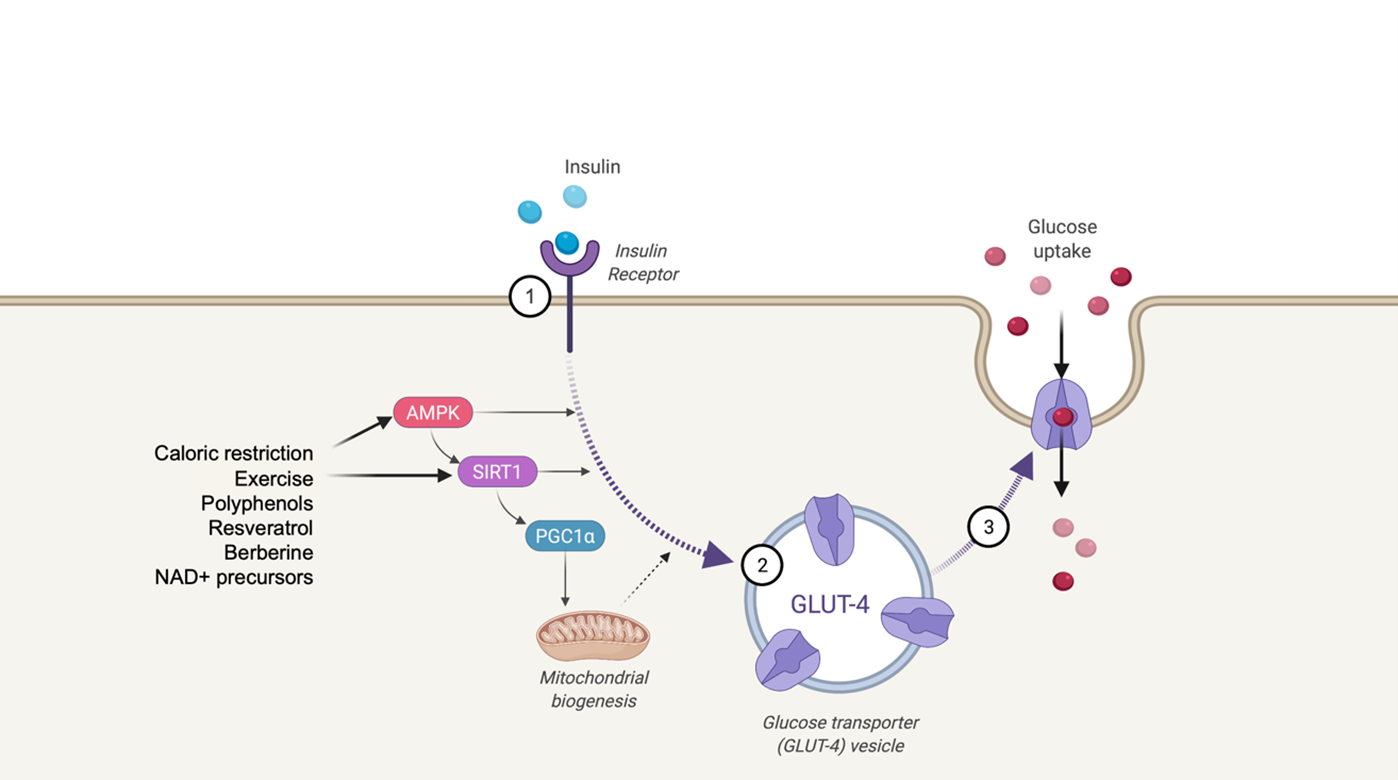
Figure 1. The AMPK-SIRT1 axis supports glucose uptake by cells. AMPK activates sirtuin 1 (SIRT1) and PPAR-gamma coactivator 1 alpha (PGC-1α) to induce mitochondrial biogenesis, which supports the function of insulin after it binds to its receptor (1), encouraging the movement of glucose transporters to the membrane (2) where glucose enters the cell to be used for energy. Image created with BioRender.com.

The benefits of AMPK activation go far beyond glucose disposal. AMPK promotes autophagy (derived from the Greek phrase “eating of self”), a process that degrades dysfunctional cells and allocates their parts and substrates toward the repair, fueling and restoration of healthier cells.4 The AMPK-SIRT1 axis is a major conduit by which caloric restriction (CR) prolongs lifespan and “healthspan” (the duration of optimal health over the lifespan) in multiple animal models.5

Some of the adaptations elicited by AMPK curtail energy-consuming processes, like cell growth and fat synthesis. For example, AMPK inhibits the proliferation of smooth muscle cells that line arteries by arresting them in the middle of the cell cycle, which helps to maintain the normal thickness of the vessel wall.1, 6 AMPK also reduces hepatic cholesterol synthesis by inhibiting HMG CoA reductase and interferes with enzymes that synthesize fatty acids in adipose tissue.

In skeletal muscle, AMPK slows cell growth (hypertrophy). This is a temporary state that switches to anabolism when a meal is consumed.  Paradoxically, AMPK activation may support post-prandial anabolism and protein synthesis by improving the insulin sensitivity of muscle cells.  Therefore, athletes trying to build muscle should include periods of low-energy intake or fasting as part of their dietary regimen. After all, insulin is the most powerful anabolic hormone in mammals. Taking advantage of AMPK could be as simple as cutting out snacks between meals or extending the overnight fasting period.

Practical Ways to Boost AMPK

  • Stop snacking. Allow the body to enter a mini-fast between meals (at least 6 hours). Exercising during this time, even if it’s a 10-minute walk, will expedite the onset of the energy deficit that’s needed to activate AMPK. Walking for just a few minutes after a meal, and even taking standing breaks while sitting, can kickstart this energy shift.7
  • Caloric restriction (CR) is the most extensively studied dietary method to up-regulate AMPK. Ample research has shown that limiting calorie intake, even modestly, enhances insulin sensitivity and metabolic regulation.1, 8 In practice, caloric restriction is difficult to deploy because of low patient compliance. Alternative protocols involving alternate day fasting (ADF) may offer similar health benefits with better long-term adherence.8 Modest reductions in overall energy intake can also activate AMPK, but it’s important to allow blood sugar to drop sufficiently between meals to engage it. 
  • Exercise is perhaps the most sustainable and well-supported method. Any exercise will suffice, as long as it burns calories and creates a temporary energy deficit. It’s important to avoid snacking before or during the workout. 
  • CR mimetics (CRMs) are small molecules that may partially recapitulate the cellular effects of CR.9, 10 CRMs lacked a unified definition until 2014 when Madeo and colleagues defined them as substances that inhibit protein acetylation, which “tunes up” metabolism, mitochondrial renewal and longevity pathways.9 To learn more, here is a short article describing CRMs.
  • Resveratrol has been shown to support the AMPK/SIRT1 axis and mitochondrial function at daily doses of at least 150 mg/day.11, 12‡
  • Berberine supports insulin receptor function and signaling, in part, by supporting AMPK activation. Human clinical trials have shown significant metabolic health benefits after 4-12 weeks of daily supplementation with 1000-1500 mg/day.13, 14 Berberine has very poor oral bioavailability, but new delivery systems can overcome this limitation. Berbervis® phytosome is 4x more bioavailable than a standard berberine formulation.15‡
  • Nicotinamide riboside and nicotinamide mononucleotide (NMN) support metabolic health by mimicking a low-acetylation state. By supplying NAD+, they directly activate SIRT1. NAD+ is made from dietary niacin and its biosynthesis declines with age.5‡
  • Polyphenols in fruits, berries, green tea and other plant foods support the AMPK-SIRT1 axis and other pathways related to cardiometabolic health.16‡

Summary & Key Points

  • AMPK is a master metabolic sensor that enhances mitochondrial function, insulin signaling and glucose metabolism.
  • Lifestyle interventions that create energy deficits, such as caloric restriction and exercise, are well-established modalities that activate the AMPK-SIRT1 axis.
  • Various phytochemicals, such as polyphenols from fruits and vegetables and resveratrol and berberine, also support AMPK and/or SIRT1 activity.

For Further Learning

Cardiometabolic Support Protocol: This protocol offers recommendations to support glucose homeostasis, lipid metabolism and healthy vascular function.

Free online course: Integration of Pharmaceuticals and Natural Products in Cardiometabolic Care

In this complimentary mini-course (60-90 minutes, at your own pace), learn how to integrate evidence-based diet and lifestyle approaches in basic cardiometabolic care.

References

  1. Herzig S, Shaw R. Nat Rev Mol Cell Biol 19, 121–135 (2018). 
  2. Burkewitz K, Zhang Y, Mair WB. Cell Metab. 2014 Jul 1;20(1):10-25.
  3. Smith BK, Steinberg GR. Curr Opin Clin Nutr Metab Care. 2017 Jul;20(4):248-253.
  4. Nakamura S, Yoshimori T. Autophagy and Longevity. Mol Cells. 2018 Jan 31;41(1):65-72.
  5. Dai H, Sinclair DA, Ellis JL, Steegborn C. Pharmacol Ther. 2018 Aug;188:140-154.

  6. Wang Q, Liu S, Zhai A, et al. Biol Pharm Bull. 2018 Jul 1;41(7):985-993.
  7. Buffey AJ, Herring MP, Langley CK, et al. Sports Med 52, 1765–1787 (2022).
  8. Stekovic S, Hofer SJ, Tripolt N, et al. Cell Metabolism, 2019; doi:10.1016/j.cmet.2019.07.016.
  9. Madeo F, Pietrocola F, Eisenberg T, Kroemer G. Nat Rev Drug Discov. 2014 Oct;13(10):727-40.
  10. Madeo F, Carmona-Gutierrez D, Hofer SJ, Kroemer G. Cell Metab. 2019 Mar 5;29(3):592-610.
  11. Timmers S, Konings E, Bilet L, et al. Cell Metab. 2011 Nov 2;14(5):612-22.
  12. de Ligt M, Bruls YMH, Hansen J, et al. Mol Metab. 2018 Jun;12:39-47.
  13. Feng X, Sureda A, Jafari S, et al. Theranostics. 2019 Mar 16;9(7):1923-1951.
  14. Baska A, Leis K, Gałązka P. et al. Endocr Metab Immune Disord Drug Targets. 2021;21(8):1379-1386.
  15. Petrangolini G, et al. Evid Based Complement Alternat Med. 2021 Nov 27;2021:7563889.
  16. Xu W, Luo Y, Yin J, Huang M, Luo F. Food Funct. 2023 Jan 3;14(1):56-73.
Blog

Weight Management

Pure Encapsulations Pro Blog


This blog explains the vital importance of how integrating weight management into your practice by first establishing foundational care and then adding in personalized approaches for your patients can help address their needs.

The Importance of Weight Management?

“Paradoxically coexisting with undernutrition, an escalating global epidemic of overweight and obesity—“globesity”—is taking over many parts of the world. If immediate action is not taken, millions will suffer from an array of serious health disorders.” – World Health Organization1

Obesity and weight gain are an epidemic, with around 70% of the US population currently considered overweight or obese with the prevalence rising 30-40% over the past two decades3.

As the WHO points out, obesity is a risk factor for many chronic conditions, including heart disease, high blood pressure, dyslipidemia, diabetes, fatty liver, sleep apnea, osteoarthritis, kidney disease, and much more. The silent symptoms not commonly reported can also include the psychosocial stress associated with being overweight or obese.1

In her lecture, Dr. Caroline Cederquist+ makes the case for Functional and Integrative medical practices to take the lead on offering weight management support for patients: “Weight management is not often addressed in the traditional medical model … [doctors] don’t have the time and the setup to really work somebody through the lifestyle adjustments that are needed to make this happen, and if 80% of functional medicine is lifestyle adjustment, then weight management really should be at the top of the list because it affects so many other medical conditions that follow it.”

She suggests establishing foundational interventions for weight management in your practice, and then adding methods of personalization to optimize care for individual patients.

Foundational Interventions

Caloric Restriction

The first step when integrating caloric restriction in your weight management plan is myth-busting—it is not about diets or only eating certain foods. Options like ketogenic or plant-based may not be appropriate for your patient, and it is vital to create an approach to food that is going to give them enough fuel to get through their day, without overloading them on calories.

Diet Higher in Protein

In order to ensure the highest quality of calories, it is crucial to establish a higher intake of protein. Reduced-calorie diets higher in protein have repeatedly been associated with healthy weight management, satiety, and body composition. Think of this like a scale—as the total amount of calories decreases each day, the amount that comes from protein must increase.

Standard diets recommend 15% of daily calories come from protein, which won’t be sufficient if overall calories are restricted. Dr. Cederquist recommends 100-140g of protein per day based on the patient’s body composition and lifestyle. While this may initially seem high, eating > 100g protein per day is associated with enhanced body composition, reduced risk of regain, and preservation of lean muscle mass.

Diet Higher in Fiber

Adequate dietary fiber supports healthy weight, satiety, cardiovascular function, the microbiome, and the innate immune response. Unfortunately, only around 5% of Americans consume the recommended amount of fiber.

When working on weight management with your patients, be sure to set reasonable expectations for increasing fiber in their diets.

Dr. Cederquist keeps it simple by suggesting two fruits and a minimum of three non-starchy vegetables per day to increase fiber and support satiety while maintaining low caloric intake.

Micronutrient Repletion

Weight gain causes stress on the body is associated with lower plasma concentration of essential vitamins and minerals. When reframing dietary intake, it is vital to ensure proper levels of micronutrients. If it is not possible or difficult to meet this need by diet alone, many patients find it convenient to take a well-balanced multivitamin to supplement micronutrient levels.

Regular Exercise

After the nutritional aspects of your weight management plan is in place, then you can begin the conversation on exercise. Exercise is more than simply burning calories; healthy levels of exercise activate AMPK and SIRT1, improves vascular function, and decreases fat in visceral adipose tissue. Of course, exercise has many mental health benefits as well, which can be helpful in offsetting the stress and pressure associated with weight.

Young woman and man cooking healthy meal at home

Personalizing Your Care

Lab Assessments

Lab assessments don’t have to be complicated, and Dr. Cederquist recommends starting with 10 basic tests to help understand weight management patients:

  • Complete Blood Count (CBC)
  • TSH, Free T3 and Free T4
  • Comprehensive Metabolic Profile (CMP)
  • Serum Vitamin B12
  • Fasting Serum Insulin
  • 5-hydroxy Vitamin D
  • HbA1c
  • Magnesium RBC
  • Lipid Profile

These tests are commonly available through services such as LabCorp® and Quest®.

Genetic Assessments

An additional test gaining popularity is a genetic test. Whether your patient has completed an at-home testing kit or you would like to order one through your lab, genetic testing can help answer important questions for those establishing a weight management care plan.

PureGenomics® is a complimentary service which offers a science-backed nutritional genomic assessment based on insights from genetic variants associated with weight management, glucose metabolism, exercise response, and other metabolic aspects of health.

Additional Assessments

The final aspect of Dr. Cederquist’s approach to weight management is to address insulin function and metabolic rate.

Regarding insulin function, Dr. Cederquist found almost 90% of the people in her clinic had labs indicating problems with insulin function. She says understanding the status of insulin function “has been the cornerstone of my medical weight loss practice in terms of really getting our patients to buy into the adequate protein and controlling the carbohydrate content—that they have to switch from high-starch carbs to more vegetables and lower glycemic carbohydrates and continuing to keep fat intake at a normal range.”

Sometimes, even when the patient does everything right, they still have a hard time getting their weight where they want it. These patients might say their metabolism is “broken” or “not what it used to be”. Of course, our bodies age and change, but to assess if metabolism is to blame for lackluster results, you can use an indirect calorimeter. This tool compares CO2 intake to CO2 output to give you metabolic rate which can help establish an understanding of metabolic rate in your patients.

Dr. Cederquist also acknowledges the important role of sleep and stress in weight management. Poor sleep and elevated stress can be related to weight gain and/or poor dietary choices. Studies have shown overtired individuals have increased levels of the “hunger hormone”, ghrelin, as well as increased salt retention, decreased levels of leptin, and decreased insulin function. To support healthy sleep habits and to lower stress levels, regular exercise can be helpful, as long as it is not within one hour of bedtime or it may interfere with sleep.

Conclusion

Achieving healthy weight management is rarely quick or simple, and often requires time and effort from both you and your patient. Dr. Cederquist’s approach helps to create a coachable care plan that will help you and your patient on the path to success by establishing a foundation and layering in personalized care for your patients.

For additional information, or to learn more, please visit our PureLean Exclusives found here.

Interested in purchasing our PureLean line of supplements from Pure Encapsulations? Please head right to our product page here.

Works Cited

  1. “Obesity and Overweight.” World Health Organization, World Health Organization, https://www.who.int/news-room/fact-sheets/detail/obesity-and-overweight.
  2. Mitchell NS, Catenacci VA, Wyatt HR, Hill JO. Psychiatr Clin North Am. 2011;34(4):717-732
  3. Fast Stats: Obesity and Overweight. National Center for Health Statistics. Last reviewed Feb 2020.
  4. Pi-Sunyer X. Postgrad Med. 2009;121(6):21-33.
  5. Moon J, Koh G. J Obes Metab Syndr. 2020;29(3):166-173.
  6. Westerterp-Plantenga MS, Lejeune MP, Nijs I, et al. Int J Obes Relat Metab Disord. 2004 Jan;28(1):57-64.
  7. Manninen AH. J Int Soc Sports Nutr. 2004;1(1):45-51.
  8. Quagliani D, Felt-Gunderson P. Am J Lifestyle Med. 2016;11(1):80-85.
  9. Hosseini, B, et al. Biol Trace Elem Res. 2016 Jun 22.
  10. Amara NB, et al. Genes Nutr. 2014 Jul;9(4):410.
  11. Gardner C, et al. Am J Clin Nutr. 2010 Aug; 92(2): 304–312.
  12. Li. et. al. Inter J of Obes. 2010. 34; 1070-1077.
  13. Dias, K. A., Green, D. J., Ingul, C. B., et al. Pediatrics, 2015. 136(3), e648-e659.
  14. Goedecke, J. H., & Micklesfield, L. K Medicine and Sport Science, 2014. 6082-93.
  15. Cooper CB, Neufeld EV, Dolezal BA, Martin JL. BMJ Open Sport Exerc Med. 2018;4(1):e000392.

PureGenomics® nutritional information is not intended for use in the diagnosis, cure, mitigation, treatment or prevention of disease.
LabCorp® is the registered trademark of Laboratory Corporation of America. Pure Encapsulations is not affiliated with or endorsed by LabCorp®.
Quest® is the registered trademark of Quest Diagnostics. Pure Encapsulations is not affiliated with or endorsed by Quest®.

+Dr. Caroline Cederquist is a retained advisor for Pure Encapsulations®.
